
Why Veterinary Compensation Is Expanding Beyond Salary and Production
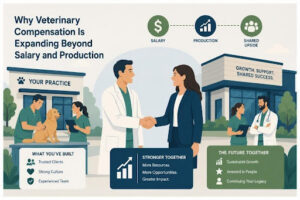
For many years, compensation discussions in veterinary medicine tended to revolve around a familiar debate: salary versus production.
Some practices preferred guaranteed salaries designed to create stability and reduce pressure on associates. Others favored production-based compensation structures intended to reward productivity and practice growth. While these models still remain common throughout the profession, the conversation has been gradually evolving.
Across veterinary medicine, many practices are now exploring broader approaches to compensation and long-term participation. These models may include profit-sharing, phantom equity, equity participation, appreciation rights, bonus pools, or other forms of what might broadly be described as “shared upside” arrangements.
Shared-upside models are not one single structure. Rather, they represent a range of approaches designed to allow veterinarians to participate not only in compensation, but also in some portion of the long-term value they help create within a practice.
This evolution reflects broader changes taking place across the veterinary industry itself.
Veterinary Practices Are Becoming Larger and More Team-Oriented
Over the past decade, many veterinary practices have become more operationally sophisticated. Multi-doctor hospitals, expanded service offerings, larger support teams, and longer operating hours are increasingly common.
Some practices are also experimenting with integrated models that combine daytime general practice with evening or weekend urgent care at the same facility. These approaches can allow practices to make fuller use of existing hospitals, equipment, client bases, and staffing infrastructure.
As practices grow in size and complexity, owners are increasingly focused on questions that extend beyond simple compensation formulas:
- How do you retain strong associate veterinarians long term?
- How do you encourage leadership and continuity?
- How do you align incentives across a growing clinical team?
- How do you create a practice environment where veterinarians feel invested in long-term success rather than simply employed?
In many cases, these questions are helping drive interest in shared-upside models.
Why Shared-Upside Models Are Becoming More Common
Several trends are contributing to the rise of these structures.
First, competition for veterinarians remains strong. Practices increasingly recognize that compensation alone may not always be enough to create long-term retention.
Second, many younger veterinarians are thinking differently about career paths than prior generations. Some still aspire to full ownership, while others may prefer participation in future growth without taking on the full operational and financial responsibilities of owning an entire practice.
Third, as practices become larger and more valuable over time, some owners believe veterinarians who help drive that growth should have an opportunity to participate in some portion of the value created.
This does not necessarily mean every associate veterinarian wants ownership.
Some veterinarians prioritize:
- stability,
- work-life balance,
- clinical autonomy,
- or predictable compensation.
Others are more interested in:
- long-term growth,
- leadership participation,
- profit-sharing,
- or participation in the future value of the practice.
There is no single “correct” structure for every veterinarian or every hospital.
Shared Upside Can Take Many Forms
One reason these conversations can become confusing is that the terminology varies widely.
In practice, shared-upside models may include:
Profit-Sharing
Under a profit-sharing arrangement, veterinarians receive compensation tied in some way to practice profitability or performance.
Phantom Equity
Phantom equity generally allows a veterinarian to participate economically in future growth or value creation without becoming an actual legal owner of the practice.
Equity Participation
Some practices offer true ownership interests, allowing veterinarians to become partial owners of the business itself.
Appreciation or Growth-Based Structures
Other models may reward veterinarians based on increases in the long-term value of the practice over time.
The structures themselves can vary significantly in terms of:
- economics,
- governance,
- taxation,
- liquidity,
- voting rights,
- and long-term expectations.
That is why clarity and thoughtful structuring matter.
Why Owners Are Interested in These Models
From an ownership perspective, these structures are often designed to encourage long-term alignment.
When veterinarians participate in the future growth of the practice, owners may believe it can:
- strengthen retention,
- encourage leadership development,
- support continuity,
- and create a stronger long-term culture.
This becomes especially important in larger or growing practices where long-term stability and team continuity can materially affect future practice value.
In some expanding practices, additional growth initiatives — such as adding urgent care services, extending operating hours, hiring additional DVMs, or broadening clinical capabilities — may significantly increase both profitability and future practice value over time.
As a result, some owners increasingly view shared-upside structures as a way to align the interests of the practice and the veterinarians helping build that growth.
Why Veterinarians Are Interested
For veterinarians, these models can create opportunities that extend beyond annual compensation.
Depending on the structure, they may allow participation in:
- future growth,
- long-term practice value,
- profitability,
- or future exit value.
Some veterinarians also appreciate the sense of participation and alignment these structures may create within a growing practice.
At the same time, not every structure works equally well for every situation.
Some arrangements involve true ownership and governance rights. Others are primarily economic participation structures. Some are relatively simple, while others may involve more complex long-term arrangements.
The details matter.
The Industry Conversation Is Still Evolving
Veterinary medicine is still in the early stages of figuring out what these models will ultimately look like over the long term.
Some practices are experimenting with straightforward profit-sharing structures. Others are using phantom equity or appreciation models. Some continue to prefer traditional partnership structures, while others remain focused primarily on compensation-based systems.
What is increasingly clear, however, is that the industry conversation is expanding beyond the traditional salary-versus-production debate.
Practices are beginning to think more broadly about:
- retention,
- alignment,
- leadership continuity,
- future growth,
- and how veterinarians participate in the success they help create.
At VetRx Solutions, we believe thoughtful alignment and long-term participation can help create stronger practices for owners, DVMs, and clients alike. As veterinary medicine continues to evolve, we expect these conversations around shared upside and long-term participation to become increasingly important throughout the profession.
