
The Shift From “Selling” to “Partnering” in Veterinary Practice Ownership
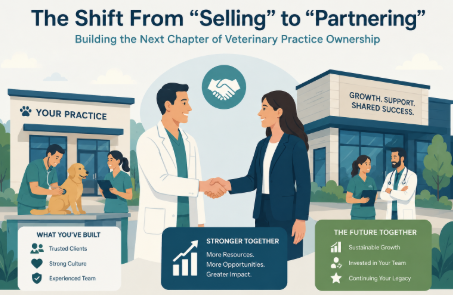
For many veterinary practice owners, the traditional idea of “selling the practice” no longer feels like the only path forward.
Historically, ownership transitions were fairly binary: either carry the full burden of ownership yourself, or sell outright and prepare to step away. But across the industry, that model is changing. Increasingly, practice transitions are being structured around partnerships and joint ventures rather than simple full exits.
This shift reflects broader pressures in veterinary medicine — staffing challenges, operational complexity, rising client expectations, and growing technology demands. Many owners still love practicing medicine and leading their teams, but fewer want to shoulder every administrative and operational responsibility alone.
In a typical partnership or joint venture structure, the owner doesn’t sell 100 percent of the hospital. Instead, they partner with a larger organization, sell a majority interest, retain meaningful ownership, and stay involved in the practice’s future growth. The owner receives liquidity while continuing to participate in the business they spent years building.
These arrangements combine the strengths of the existing practice with additional infrastructure, purchasing power, management support, and strategic resources — while the owner often remains involved clinically, strategically, or both. The conversation shifts from “leaving” to evolving the ownership structure into something designed for the next stage of growth.
One reason these models have become more common is that veterinary practices are deeply relationship-driven. Client trust, team stability, and leadership continuity are closely tied to the founding veterinarian. When handled thoughtfully, partnership structures help preserve that continuity while reducing the operational burden on the owner.
There’s also a financial dimension beyond initial liquidity. When a partnership strengthens operations, expands services, and preserves practice culture, the resulting growth can materially improve future exit outcomes. The most successful partnerships aren’t built around growth at any cost — they’re built around sustainable growth that protects what made the practice valuable in the first place.
Some partnerships also create opportunities to expand in ways that would be difficult independently — investments in staffing, technology, or service-line additions like after-hours urgent care using the same facility and client base already in place.
That said, not all partnership structures are the same, and careful screening matters. Cultural fit, decision-making philosophy, and approach to preserving the existing team and client experience should all be evaluated before moving forward. Many owners today are weighing more than purchase price — they’re evaluating whether a potential partner respects the clinical identity and reputation they’ve spent years building.
Partnership models aren’t the right fit for everyone. Some owners prefer full independence; others want a clean exit. These structures do require shared decision-making and ongoing involvement after the transaction closes. For many owners, though, that ongoing involvement is part of the appeal.
What’s becoming clear is that veterinary ownership transitions are no longer one-size-fits-all. The choice isn’t simply between carrying the full burden alone or walking away entirely. For the right owner and the right partner, a joint venture can offer a different path — one that reduces operational pressure, preserves practice culture, and builds long-term value together.
