
Will AI Recommend Your Clinic When Pet Owners Ask for ‘The Best Vet Near Me’?
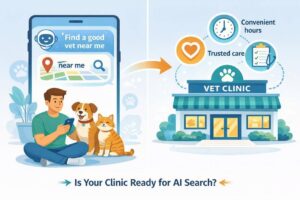
Pet owners are already starting to ask AI assistants like ChatGPT and Gemini to recommend veterinary clinics, and you can actively shape whether they recommend you by aligning your content around real client questions, clear service descriptions, and proof that you’re a trustworthy, convenient choice.
Why AI is a new “front door”
Pet owners are increasingly skipping straight to AI tools and asking them who they should see, not just what they should search for. These tools pull from your website, Google presence, reviews, and other online signals to generate confident, specific recommendations.
That means the question is shifting from “Are we on page one for ‘vet near me’?” to “Are we the obvious answer when an AI assistant is asked for the best vet nearby for this particular situation?”
How pet owners actually ask AI
Traditional search still looks like this:
- “vet near me”
- “puppy vaccines vet”
- “dog vomiting vet”
But AI prompts sound more like real conversations:
- “We just got a Labrador puppy and need to find a good vet nearby.”
- “My dog has been vomiting since this morning—should I take him to a vet today?”
- “We just moved to [your city] and need a veterinarian for our two dogs.”
Prompts in AI tools are already longer and more conversational than typical search queries, and experts expect that trend to continue as people get more comfortable with AI assistants.
If that’s how pet owners are asking, then the job of your website, reviews, and social media is simple: make it incredibly easy for AI to see that you’re a strong, relevant match for those situations.
Step 1: Map your real-world “AI moments”
The best clues about how people talk to AI are already in your team’s conversations with patients. Your receptionists and technicians hear these “AI-style” questions every day, often word-for-word.
Run a 30–45 minute team huddle and answer these questions:
-
- What situations most often bring new clients to our clinic?
Examples: new puppy/kitten visits, urgent same-day illness, ear infections and skin issues, dental disease, new-to-the-area pet owners, end-of-life care. - How do clients actually describe those situations?
Capture phrases, not just diagnoses:- “My dog has been throwing up since this morning.”
- “We just adopted a kitten and need her first shots.”
- “We need a vet open after work—our dog isn’t acting right.”
- “We just moved here and need a new vet for our two older cats.”
- What situations most often bring new clients to our clinic?
- Does your practice offer unique services or specialties?
-
- “My dog’s ear has a bad smell and it’s getting worse.”
- “Our dog’s very anxious and we need a Fear Free vet.”
- “Our dog has been limping and cries when we touch her hip area.”
Now, ask the call-to-action question: Where do those same situations and phrases live on our website?
If the answer is “buried in a bullet list on our Services page,” it’s time to surface them. Also, don’t forget to refresh team bios.
Step 2: Rewrite service pages for “AI-readable” clarity
AI systems do more than count keywords—they connect situations to services and then to the kind of clinic that is most likely to help. You can make that job much easier.
Here are concrete tweaks for small animal practices:
- Create or update “situation-based” sections
Instead of a generic “Services” page, add clearly labeled sections (or separate pages) such as:- “Sick Pet and Same-Day Visits”
- “New Puppy and Kitten Care”
- “Dental Cleaning and Bad Breath”
- “Allergies, Itchy Skin, and Ear Infections”
- “Senior Dog and Cat Wellness”
- “New to the Area? Start Here”
- Use client language in your headings and first sentences
Example for a sick pet page:- Heading: “Same-Day Vet Visits for Vomiting, Diarrhea, and Other Urgent Pet Problems”
- First line: “If your dog has been vomiting since this morning or your cat suddenly seems very lethargic, our team can usually see you the same day.”
- Be explicit about logistics
AI tools look for practical details that matter to pet owners:- Same-day or next-day availability
- Evening or weekend hours
- Whether you take new clients
Step 3: Make your strengths easy to “quote”
When someone asks “Who’s the best vet near me for X?”, AI doesn’t just look for any vet—it looks for one it can describe confidently.
Help it out by putting your differentiators into short, quotable statements:
- “Locally owned, small-animal practice serving [your city] pet families since 2005.”
- “Evening hours three nights a week for working pet parents.”
- “Fear Free Certified team focused on low-stress visits.”
- “Separate cat entrance and exam rooms for a calmer feline experience.”
- “On-site digital X-ray, in-house lab, and ultrasound for same-day answers.”
Then, tie those strengths to specific situations:
- “New puppy owners love our wellness care plans that bundle exams, vaccines, and parasite prevention into one predictable monthly fee.”
- “For vomiting dogs and other urgent concerns, we offer same-day sick visits and can discuss whether your pet needs emergency care or can be seen here first.”
These short, specific lines make it easier for AI to say something like, “Clinic X offers same-day sick pet appointments and evening hours and is well-rated for new puppy care.”
Step 4: Optimize your Google and social media presence for AI referrals
AI assistants don’t use your website in isolation—they also scan your Google Business Profile and reviews.
Action items for small animal clinic owners:
- Update your Google Business and Social Media Profiles
- Choose precise categories (e.g., “Animal hospital,” “Emergency” or “Urgent Care” only if appropriate).
- Add services that mirror your website wording: “Puppy and kitten vaccines,” “Same-day sick dog appointments,” “Senior pet wellness exams.”
- Post short, regular updates about real cases and services : “This week we’ve been helping lots of itchy dogs with allergy flare-ups—call us if your pet is uncomfortable.”
- Encourage reviews that mention specific situations
Without scripting reviews, you can nudge: “If you found us helpful for your new puppy visit or a recent urgent illness, we’d be grateful if you’d mention that in your review.” - Keep hours and contact details spotless
Mismatched hours or missing phone numbers create doubt and can push algorithms to recommend a competitor whose details are cleaner.
Step 5: Use AI as a “mystery shopper”
You don’t have to guess how AI sees you—you can test it.
Try prompts that sound like your callers:
- “We just adopted a rescue dog and want to schedule his first vet check—who is the best veterinarian near [your Zip code]?”
- “My cat has been hiding and not eating for two days. Is there a vet near [your neighborhood] who can see her today?”
- “Looking for a good vet near [your city] with evening hours for working pet parents.”
Do this in several tools (ChatGPT, Gemini, Perplexity, Claude, Grok—all have free versions) and note:
- Which clinics are mentioned by name.
- How those clinics are described.
- What details keep showing up: same-day care, specific services, reputation, hours, etc.
Then, adjust your own content so that if an AI tool were writing a one-sentence description of your clinic, it would have the right raw material: clear services, strong differentiators, and proof you’re trusted.
Step 6: Make booking the easy, obvious next step
Once an AI assistant has recommended you, the next job is to make booking nearly frictionless.
Check that:
- Your phone number is prominent and tappable on mobile.
- Online booking or request forms are easy to find from every service page.
- Instructions for urgent concerns are clear: “For vomiting, trouble breathing, or other urgent problems during our open hours, please call us so we can triage your pet and find the fastest way to help.”
When AI tools send pet owners to a clinic that’s easy to contact and book with, those visits are more likely to convert into actual appointments.
Summing up
AI search is not replacing traditional search overnight, but it is quickly becoming a second front door to your clinic. If you treat your website and online profiles as a conversation with a worried pet owner—and give AI tools everything they need to “overhear” that conversation—you put your practice in a much stronger position to be the answer when someone asks, “Who’s the best vet near me?”
